

Port-Wine Stain (Nevus Flammeus)
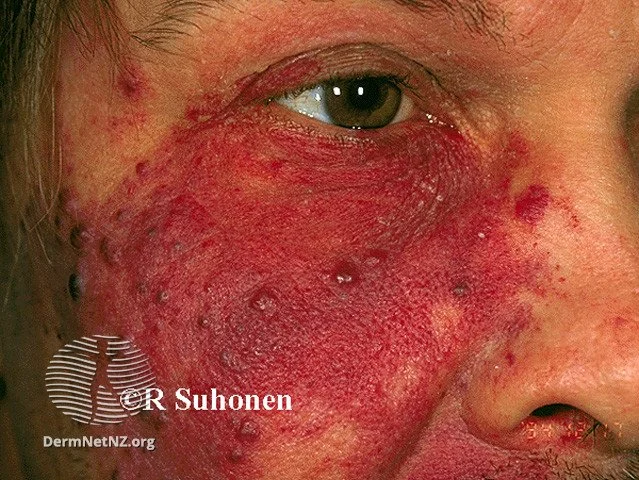
Port-wine stains are capillary malformations often on the face. There can be proliferative nodules as seen here.
Credit: DermNet NZ
What are port wine stains?
Port-wine stains are capillary malformations that are present at birth. They usually appear as flat pink, red, or purple patches and most often occur on the face, neck, or other areas of the body. Over time, they can darken, thicken, or develop a more textured surface.
These are vascular birthmarks, not infections or bruises.
What causes port wine stains?
Port-wine stains are usually caused by a vascular malformation that develops before birth. In most cases, they are sporadic rather than inherited. They reflect abnormal small blood vessels in the skin rather than something a parent caused or could have prevented.
In some cases, especially when they affect certain parts of the face, they can be associated with specific syndromes or eye and neurologic issues, which is one reason some patients need broader evaluation.
What are the symptoms of port wine stains?
Port-wine stains manifest as:
Flat areas of purple or dark red skin with well-defined borders.
A surface that may begin lighter in hue at birth but can darken or become bumpy with age.
Predominant appearance on one side of the body, without crossing the midline.
Notably:
The face is the most commonly affected area, but the neck, upper torso, arms, and legs can also be involved.
The aesthetic aspect of the stain can be distressing, potentially impacting psychological well-being, especially in children.
How do I treat port wine stains?
Treatment depends on the location, size, age of the patient, and cosmetic or functional concerns.
Common approaches include:
Pulsed dye laser or other vascular laser treatment
Observation when treatment is not desired
Monitoring for associated issues in selected facial lesions
Treatment of thickened or nodular areas when needed
Laser treatment often improves color, but multiple sessions are commonly needed and complete clearing is not always possible.
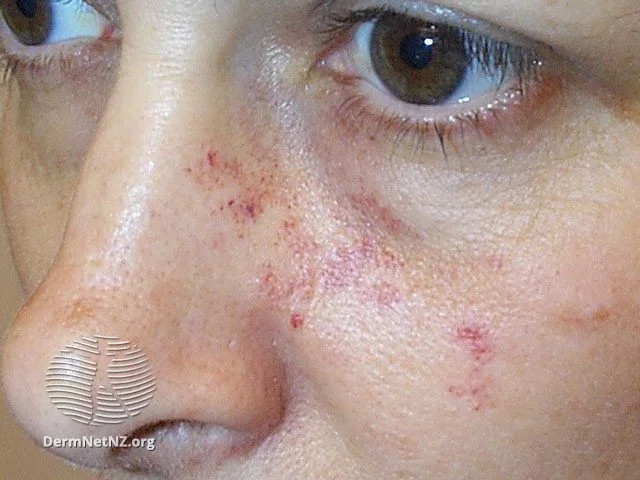
A mild capillary malformation. Not all capillary malformations develop as port wine stains.
Credit: DermNet NZ
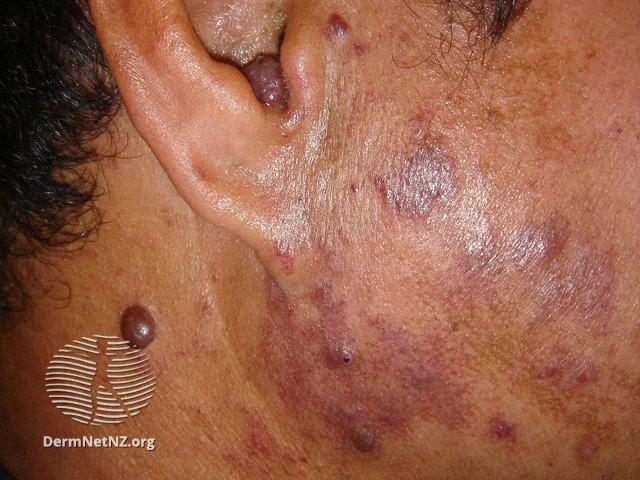
Sometimes the port-wine stains will develop proliferative nodules which can be removed if needed.
Credit: DermNet NZ