
Basal Cell Carcinoma: Symptoms & Treatments

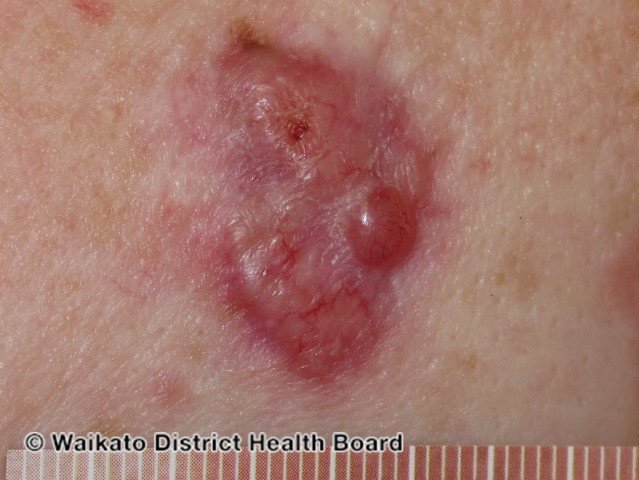
An example of basal cell carcinoma, which looks like a shiny, pink bump or blemish on sun-damaged areas.
Credit: DermNet NZ
What is basal cell carcinoma?
Basal cell carcinoma is the most common form of skin cancer. It usually develops slowly and often arises in areas with significant cumulative sun exposure, especially the head, neck, and other sun-exposed skin.
Although it usually grows more slowly than many other cancers and rarely spreads to distant sites, it can still become locally destructive if allowed to continue growing.
What causes basal cell carcinoma?
Basal cell carcinoma is strongly associated with ultraviolet damage over time. Risk factors include:
Cumulative sun exposure
Tanning bed use
Fair skin and lighter eye or hair color
A history of multiple skin cancers
Immunosuppression in some patients
Age over 50
What are the signs of basal cell carcinoma?
Basal cell carcinoma can appear in several ways, including:
A pearly or translucent bump
A sore that does not heal well
A pink patch
A scar-like or firm area
A lesion that bleeds easily or crusts repeatedly
How is basal cell carcinoma treated?
Treatment strategies for BCC depend on factors such as location, depth, and size of the carcinoma. Typically, surgical excision under local anesthesia in a clinical setting is the primary approach. Other treatment options include:
Mohs Micrographic Surgery: This technique involves sequential removal of skin layers, particularly in high-risk or cosmetically sensitive areas.
Superficial Radiation Therapy (SRT): SRT is a non-surgical, painless treatment that uses low-dose radiation to target cancer cells at the skin's surface while minimizing exposure to healthy surrounding tissue.
Electrodesiccation and Curettage: This method involves scraping away the lesion and using an electric needle to treat the area.
Cryotherapy: Freezing is generally reserved for smaller or superficial lesions.
Oral Medications: Such as vismodegib (Erivedge) or sonidegib (Odomzo), which might be considered for difficult-to-excise areas or when multiple lesions are present.
Topical Medications: Imiquimod or 5-fluorouracil (5-FU) are used primarily for superficial lesions.
How do I prevent basal cell carcinoma?
Helpful strategies include:
Routine sunscreen use
Regular skin checks
Reporting new or changing lesions promptly
Wearing hats, and using protective clothing are crucial preventive measures
Early detection and treatment of basal cell carcinoma are crucial for optimal outcomes. Regular skin examinations with your dermatologist and being aware of any new or changing lesions can aid in maintaining healthy skin.

Superficial basal cell carcinoma can resemble eczema or psoriasis.
Credit: DermNet NZ

Basal cell carcinoma that is pigmented can resemble melanoma.
Credit: DermNet NZ